Does Page Length Matter When It come To Conversions?

With the ubiquity of digital ads, it is hard to keep users' attention. What kind of landing page design would be complementary to digital ads and generate leads with the shortest glance? Would landing pages with shorter page lengths grab more of the user's attention? Since scroll depth acts as an important indicator of how engaged users are in the page viewed, it is reasonable to find out the correlation between scroll depth, page length, and lead generation.
🤔 Hypothesis
An EdTech company was promoting a children's DIY product. Based on Facebook audience analysis, the target audience is 28-48 aged moms. In this digital campaign, to refine the TA, 3 landing pages were created at different page lengths based on TA copywriting
TA1-2: moms who value quality interaction time with children
TA2: moms who would get a break and relax by having their children use the product
TA3: moms who value exploratory learning and want to participate in learning with their children
The copywriting was analyzed by the readability scoring system CRIE by National Taiwan Normal University. The 3 pages have an equal score (102) so copywriting is not considered a prominent variable.
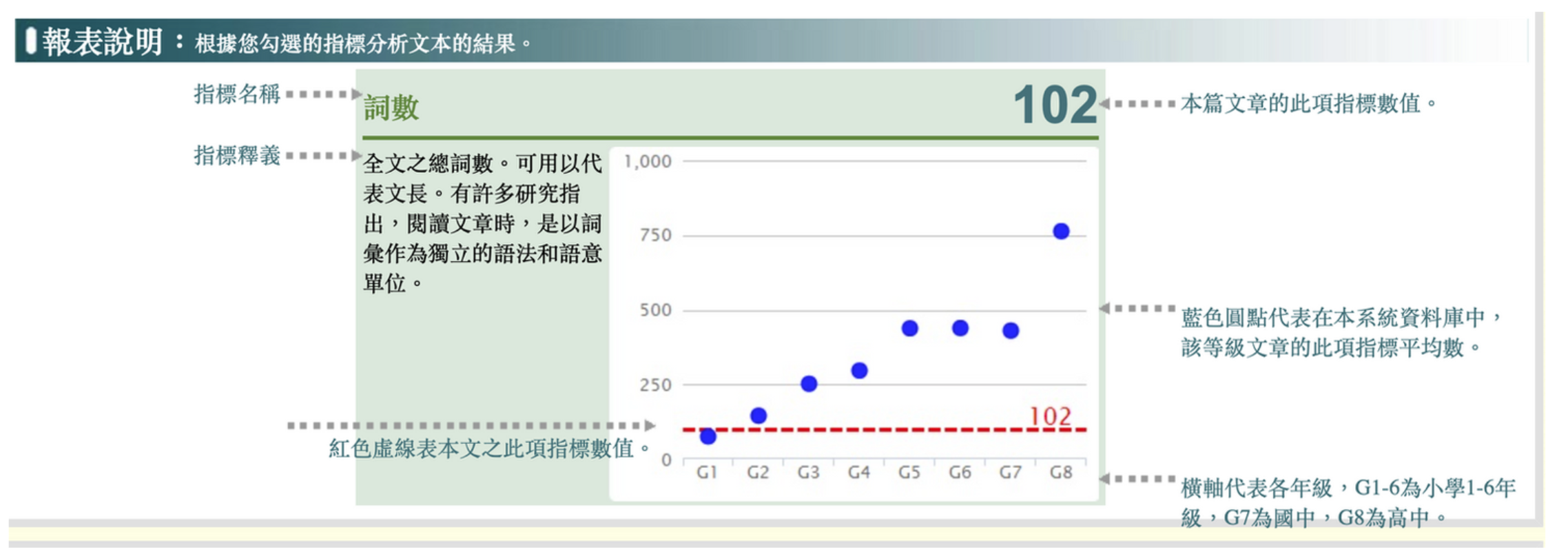
The pages used the same site structure and the contact forms were placed on the bottom of the pages. It was believed that the shortest page length should have the best performance of form submission.
🧪 Methods
Context
An EdTech company was promoting a children's DIY product using 3 landing pages of different lengths based on TA copywriting. The Call-to-Action offered a free course video for anyone who submitted a contact form An EdTech company was promoting a children's DIY product using 3 landing pages of different lengths based on TA copywriting. The Call-to-Action offered a free course video for anyone who submitted a contact form
Variables
The 3 pages were under the same site structure and had very similar copywriting styles. The main differences lie in the page length:
TA2 > TA1-2 > TA3The 3 pages were under the same site structure and had very similar copywriting styles. The main differences lie in the page length:
TA2 > TA1-2 > TA3
Data analysis
Hotjar was employed to track the page scrolling performance. Google Analytics was used to track conversion.
📋 Result
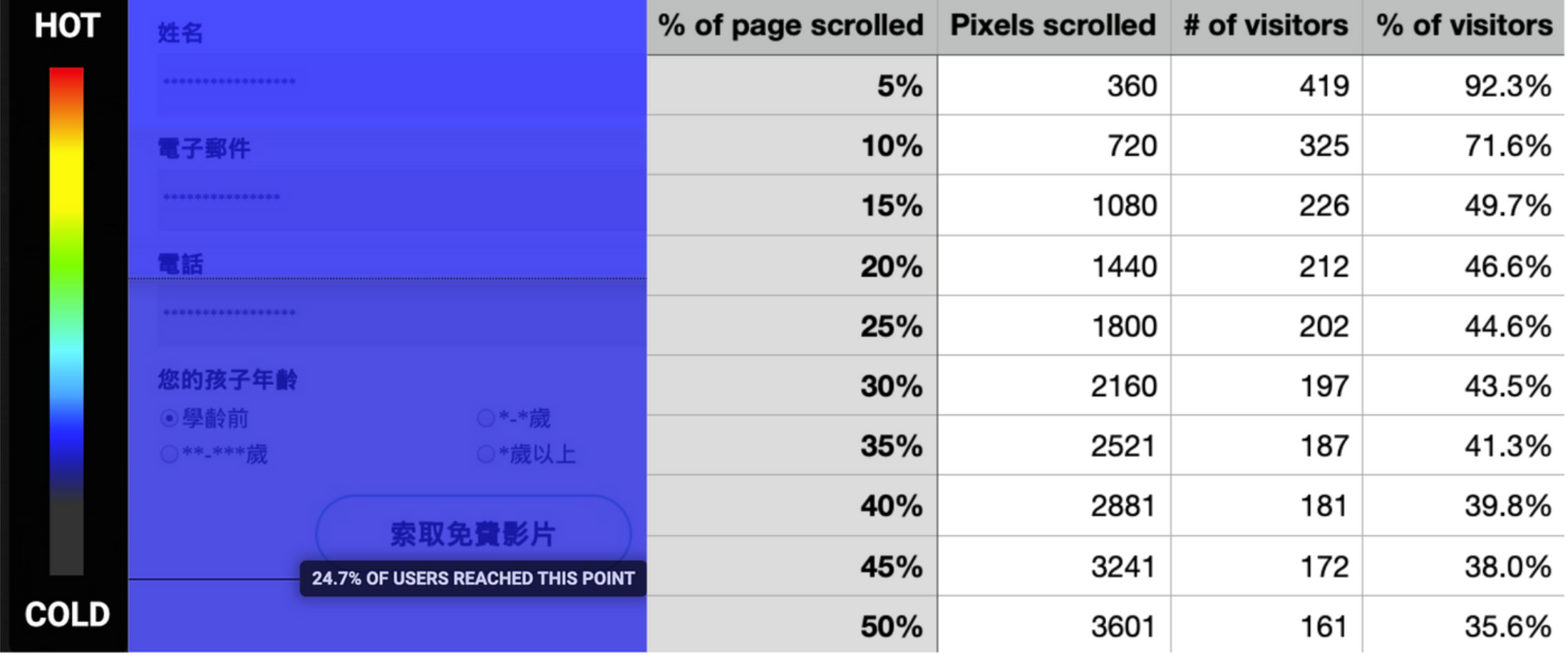
Page TA2's scroll depth is 24.7%, and at least 46.6% of visitors scrolled to the form submission. The form submission received was 0. Page TA2's scroll depth is 24.7%, and at least 46.6% of visitors scrolled to the form submission. The form submission received was 0.
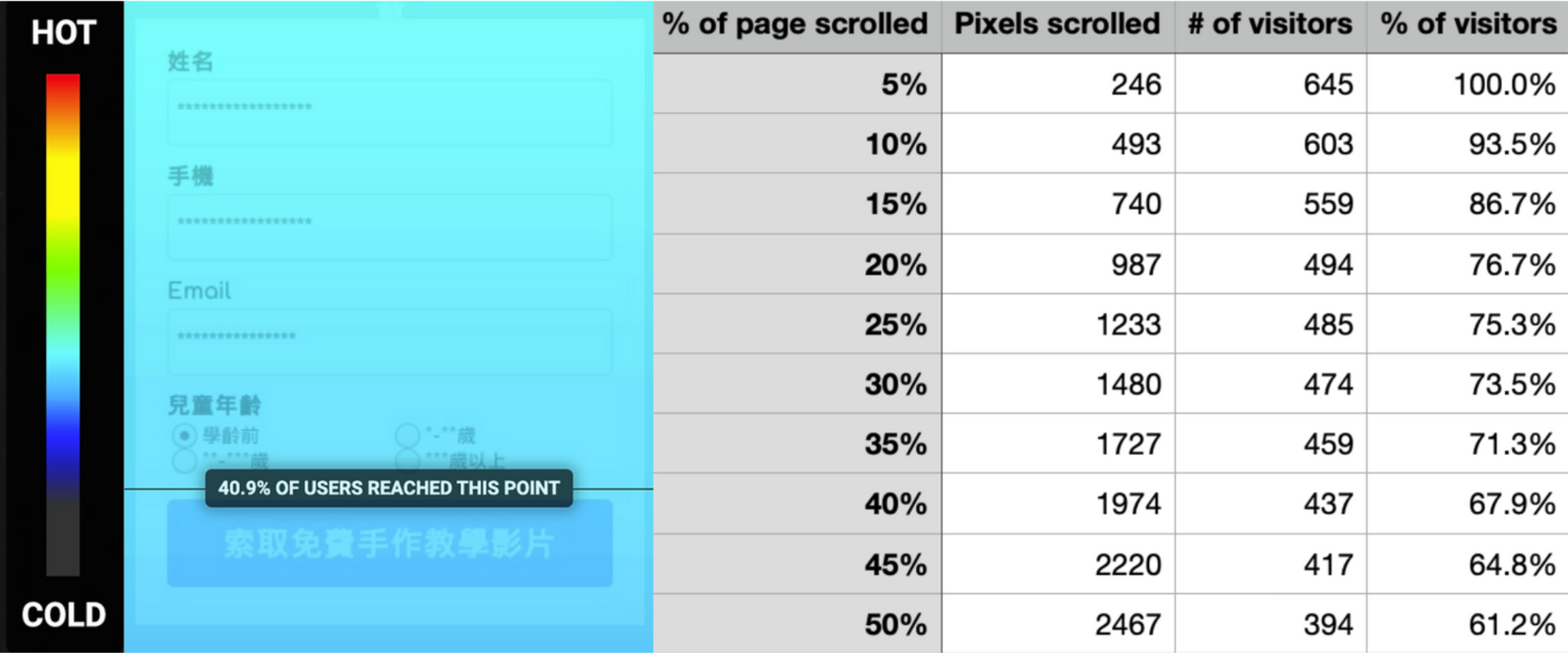
The landing page TA3's scroll depth was 40.9%, and at least 67.9% of visitors scrolled to the form submission. The form received 5 potential customers and generated 1 purchase.
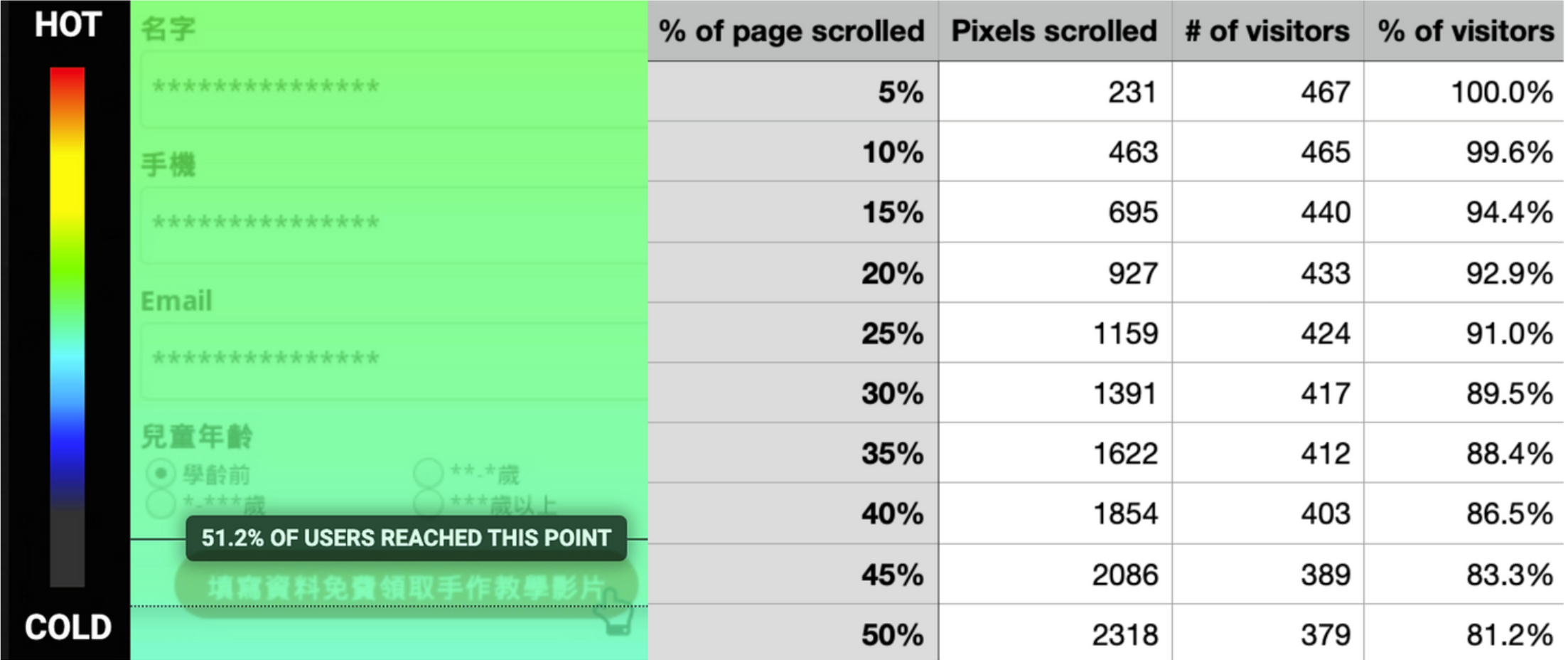
The landing page TA1-2's scroll depth is 51.2%, and at least 81.2% of visito scrolled to the form submission. The form received 3 potential customers and generated 1 purchase.
From the correlation table, the shortest page TA3 length had the best performance of form submission (62.5% contribution). The page TA1-2 had the 2nd best performance (37.5% contribution), yet it had the best scroll depth of all (51.2 %). From the correlation table, the shortest page TA3 length had the best performance of form submission (62.5% contribution). The page TA1-2 had the 2nd best performance (37.5% contribution), yet it had the best scroll depth of all (51.2 %).
.png)
📈 Marketing Insights
In this research, the top performance pages have a total of 816 visitors who scrolled down to the CTA section (40.9% - 51.2% scroll depth). We can infer that when designing a landing page, page length should be kept short enough to hold the visitor's attention and long enough to elicit visitors to have to scroll down to find the information. Since around 50 % of visitors scrolled down to the bottom of the page where the form (CTA) was placed, the next optimizing option to consider is placing CTA upward so it could hold the chance to be seen by at least half of the visitors.